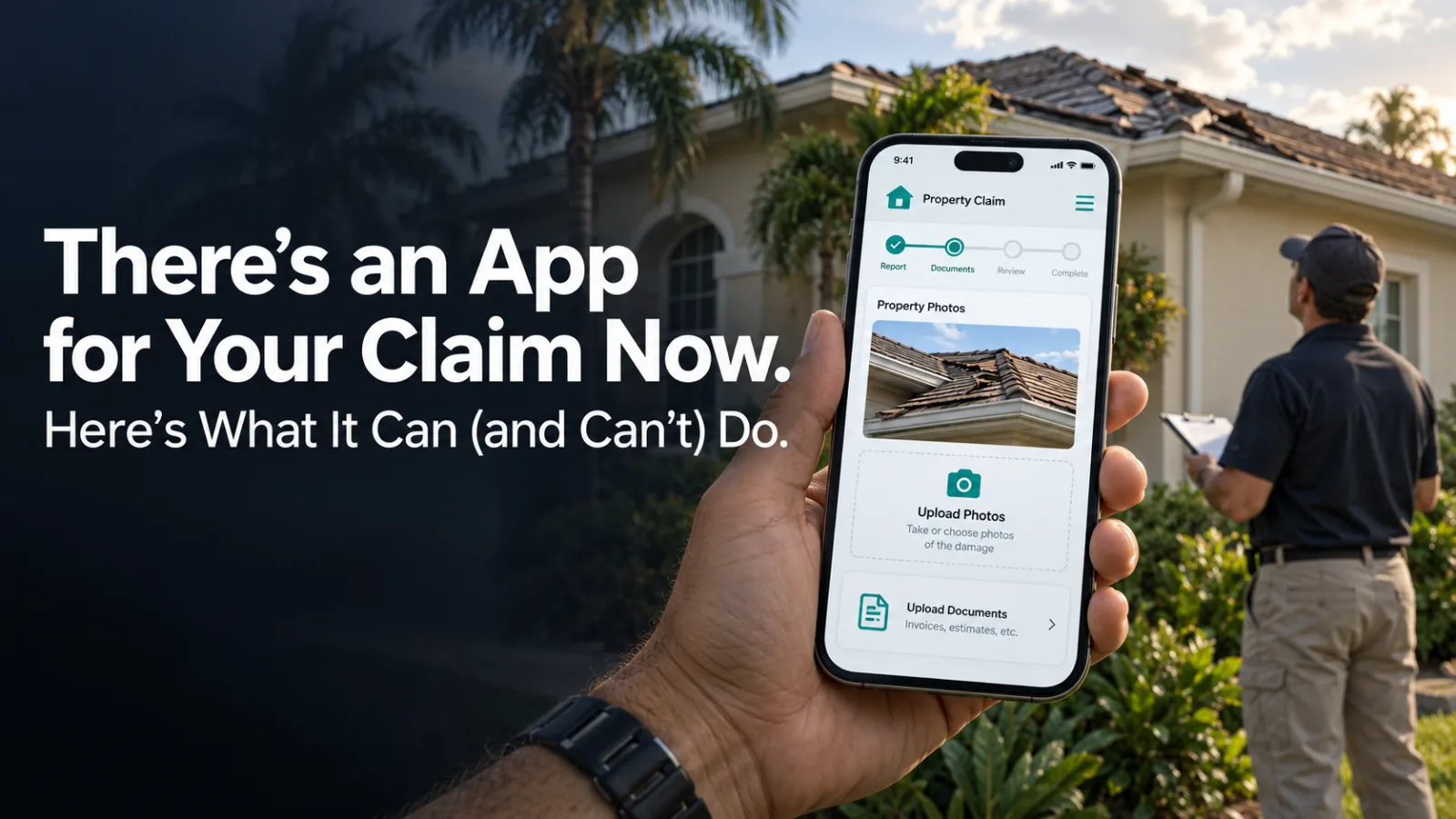
There's an App for Your Claim Now. Here's What It Can (and Can't) Do.
Ten years ago, a homeowner with storm damage had three options: call the carrier and hope, call a contractor and hope, or call a public adjuster. The process ran on phone calls, faxed forms, and a claim file you never got to see.
That's changing fast. Open an app store today and search "insurance claim" and you'll find dozens of tools promising to document your damage, decode your policy, track your deadlines, and draft your letters. Carriers have their own apps. Contractors have inspection apps. And a new category is emerging aimed squarely at the policyholder — the person who's actually living in the damaged house.
We think this shift is a good one. A homeowner who understands their own claim is a homeowner who gets treated better. Here's a look at what's driving the boom, what these tools do well, and where a licensed professional still fits in.
Why this is happening now
Three things converged.
Phones got good enough to be evidence. A modern smartphone captures geotagged, timestamped, high-resolution photo and video. That's not a convenience — that's a documented record of condition. Ten years of adjusters arguing about "pre-existing damage" ran into a device that can prove what a roof looked like on a specific afternoon.
Florida's legal landscape squeezed the middle. The 2022 reforms (SB 2-A) and HB 837 in 2023 reshaped who gets involved in a claim and when. One-way attorney fees are gone. Assignment of benefits for property claims is effectively off the table. Notice deadlines tightened — under Fla. Stat. § 627.70132, a new or reopened claim is generally barred unless the insurer gets notice within one year of the date of loss, and a supplemental claim within 18 months. Meanwhile, § 627.70131 gives the carrier 60 days to pay or deny once you've given notice.
What that adds up to: fewer attorneys taking marginal claims, a shorter runway for homeowners, and a much higher penalty for not knowing what you're doing. That's a gap. Software rushes into gaps.
AI made document work cheap. Reading a 90-page HO-3 policy and telling someone what their Coverage A limit is, whether they have Ordinance & Law, and what their windstorm deductible actually costs them used to require a person. Now it requires a model and a few seconds. The same is true for reading an insurer's estimate and flagging that the roof line item has no starter course, no drip edge, and no ice-and-water shield.
What these tools are genuinely good at
We've spent a lot of time in this space, and we'd rather tell you where software wins than pretend it doesn't.
Organizing the file. Most claims that go sideways don't go sideways because of one bad decision. They go sideways because nobody kept a record. Who did you talk to on August 3rd? What did they say about the mitigation invoice? When did you send the roof photos? An app that timestamps every document and every contact is doing something most homeowners will never do in a shoebox.
Deadline tracking. The one-year and 18-month windows above are hard stops. So are the proof-of-loss deadlines in your policy, and the appraisal demand windows. These are exactly the kind of thing a calendar-aware tool should never let you miss.
Policy translation. Insurance policies are written in a dialect. Software that can tell you, in plain English, what your ACV settlement means versus RCV — and that you have to actually complete the repairs to recover the depreciation holdback — is closing a real information gap.
Estimate literacy. When the carrier's estimate arrives, most homeowners look at the bottom-line number. The number isn't the story. The line items are. A tool that helps you see that a 2,400 sq ft roof was estimated without ridge vent replacement, or that overhead and profit was stripped from a job with four or more trades, is teaching you to read the document that determines your check.
Draft communications. A well-structured letter asking your carrier to explain a coverage position, citing the policy language, dated and documented, is worth a great deal. You should be sending those. Software can help you write them.
Where a licensed professional still comes in
None of this replaces having someone licensed in your corner on a hard claim. It's better thought of as the layer underneath — the tool handles the record-keeping and the reading, and a professional handles the parts that require a person.
Representation is a licensed role. In Florida, § 626.854 defines what it means to adjust a claim on someone else's behalf — investigating, evaluating, negotiating, advising on disposition. A good consumer app is a tool you use on your own claim; it isn't standing in for a licensed adjuster, and the reputable ones say so clearly. Worth checking that any product you're considering is upfront about the distinction.
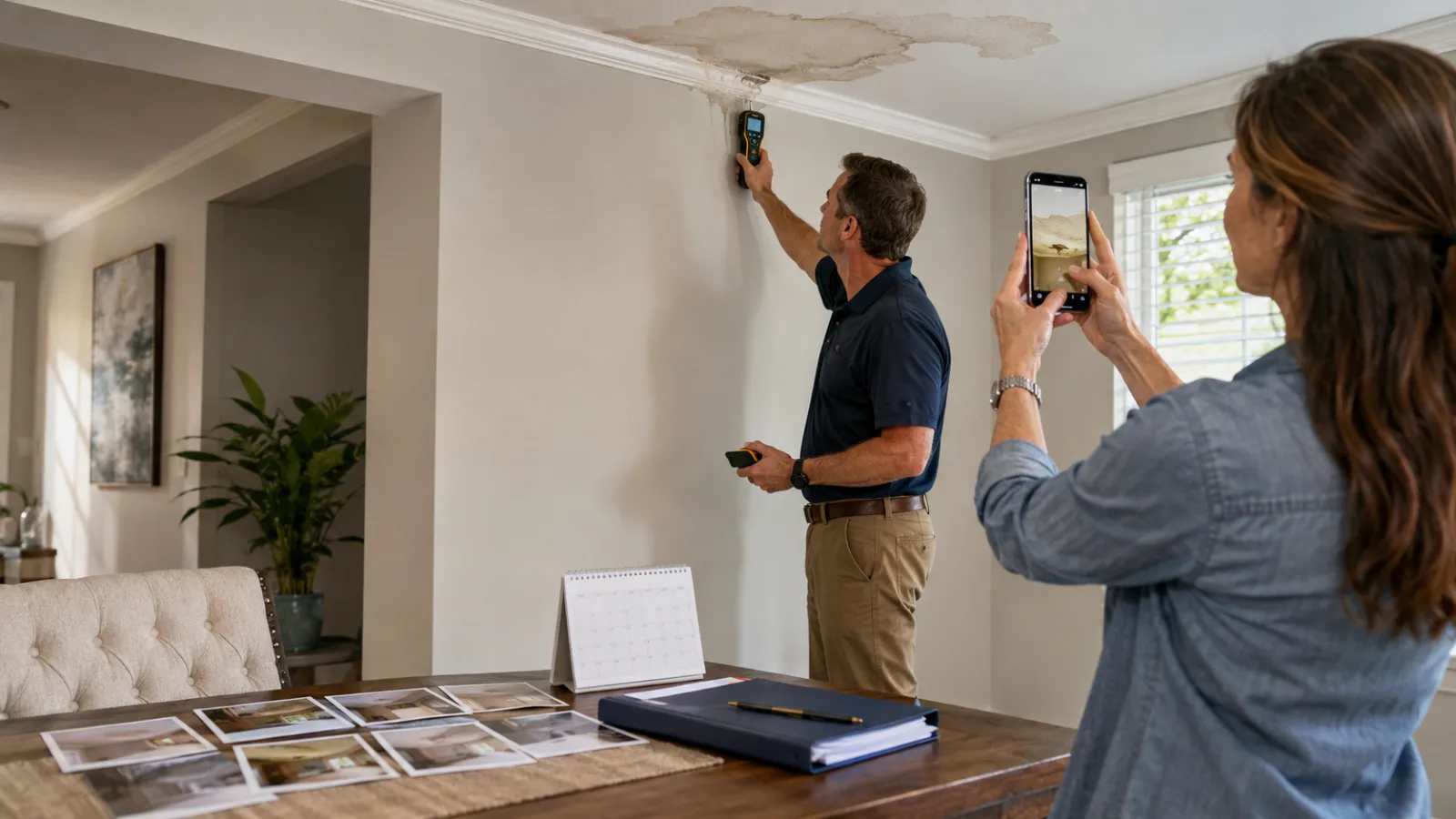
Someone has to actually get on the roof. An app works from what you captured. An experienced adjuster on site knows to pull the ridge cap, check decking spacing for code-upgrade exposure, look at what the neighbors replaced, and recognize when "wear and tear" is really mechanical damage from a prior bad install. That's a field call, not a software one.
Negotiation is a conversation. On a difficult claim there's a point where it comes down to two people who both know the pricing database, both know the policy, and both know what happens if they don't agree. Good documentation gets you to that table in strong shape. Someone still has to sit at it.
Verify the important numbers. Any AI-assisted tool is working from what it's been given, so treat the material items — a deadline, a coverage position, a dollar figure — as things to confirm against your actual policy and correspondence. That's ordinary good practice with any summary, not a knock on the technology.
How to evaluate a claims app
If you're going to use one — and we think most homeowners should — here's what we'd look at:
Does it tell you plainly what it is? Educational tool, document organizer, or licensed representation. Products that blur this are the ones to worry about. Who owns it, and who gets referred? Many of these tools refer out to adjusters, attorneys, or contractors. That's not inherently bad. Undisclosed is bad. Look for a clear affiliate disclosure. What happens to your photos and documents? Your claim file contains your address, your policy number, and photographs of the inside of your house. Read the privacy policy. Check whether your content is used to train models. Does it push you toward a decision or toward understanding? Good tools make you more informed. Tools designed to funnel you into a signed contract in three taps are lead generation wearing a UI. Does it acknowledge its own limits? An app that tells you when to call a licensed professional is more trustworthy than one that implies you'll never need one. Where we land
The honest position, from a firm that makes its living representing policyholders: most claims don't need us.
A straightforward covered loss, a reasonable adjuster, an estimate that's basically right — you can handle that yourself, and you'll handle it better with good software than without. We'd rather homeowners have that than not.
What we do is for the other cases. The denial that cites a policy exclusion that doesn't apply. The $14,000 estimate on a $47,000 loss. The claim that's been "under review" for 70 days. The roof where the difference between repair and replacement is a matching argument nobody at the carrier wants to have. Those need someone licensed, on site, with the pricing knowledge and the willingness to push.
If you're looking for a place to start, Pocket Adjuster is one of the newer options built specifically for homeowners rather than for professionals — policy explanations in plain language, damage documentation, an organized claim file, and deadline tracking. It's launching soon and worth a look if you have an open claim or expect one.
Until then: document everything, watch your deadlines, read the line items and not just the total, and call someone licensed when the numbers stop making sense.
NeJame Claims Adjusting is a licensed Florida public adjusting firm (License #P124170 / #W805417). This article is general information about the claims process and is not legal advice or a coverage opinion on any specific claim. Statutory references reflect Florida law as of publication and are subject to change.