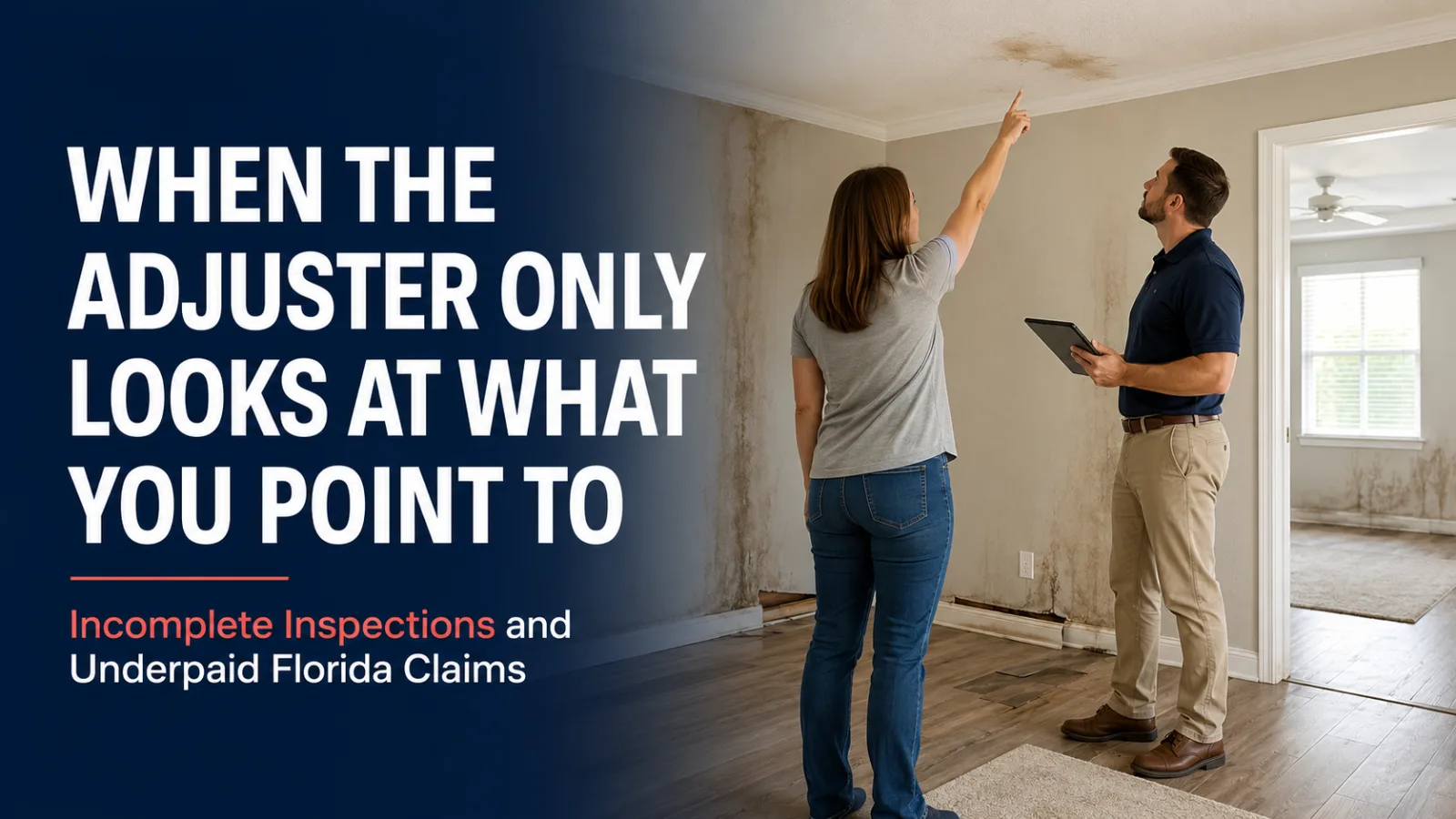
When the Adjuster Only Looks at What You Point To: Incomplete Inspections and Underpaid Florida Claims
Most Central Florida policyholders assume the carrier's inspection is the thorough part of the claim. You report the loss, an adjuster comes out, and whatever they find becomes the claim. That assumption is where a large number of underpaid claims begin.
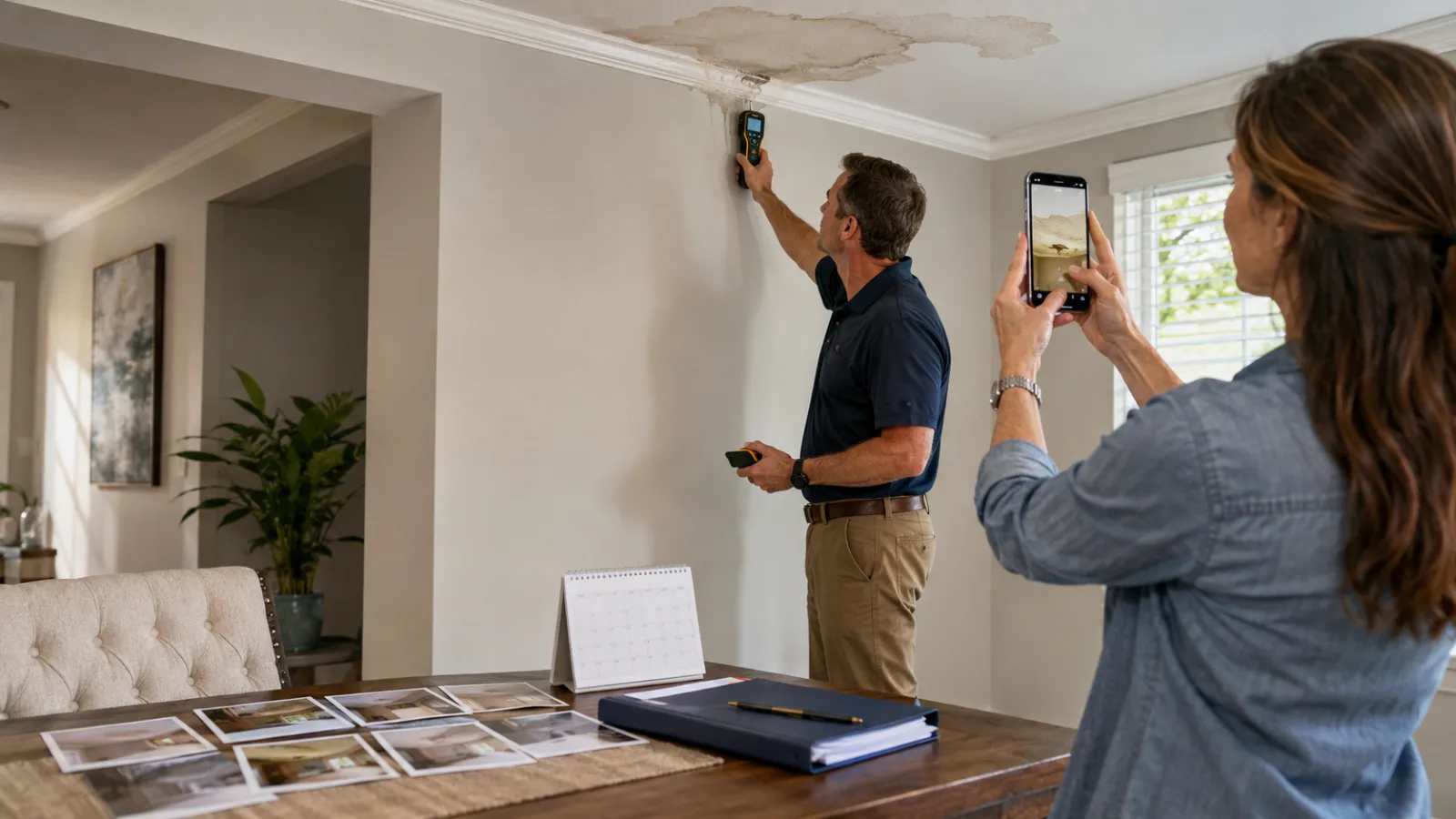
Here is what the inspection often looks like in practice. You meet the adjuster at the front door. You point out the stained ceiling in the living room. They photograph the stain, take a few moisture readings in that room, spend twenty minutes at the property, and leave. Three weeks later an estimate arrives covering drywall repair and paint in one room, and nothing else.
The estimate is not wrong about the living room. It is incomplete about the loss. And because the estimate becomes the carrier's official position, the burden quietly shifts to you to prove that everything the adjuster did not look at is also part of the claim.
The scope of the inspection becomes the scope of the claim
An insurance estimate is a document built from an inspection. If the inspection captured three rooms, the estimate covers three rooms. If the adjuster never opened the attic hatch, never lifted a section of carpet pad, never checked the adjacent closet, and never got on the roof, none of that appears anywhere in the file.
This matters more than it sounds, because nothing in the estimate says "not inspected." It simply says nothing. To anyone reading the file later — a supervisor, a desk adjuster reviewing your supplement, an appraiser, a mediator — the absence reads as an absence of damage rather than an absence of inspection.
Water losses show this most clearly. Water moves along framing, wicks up drywall, travels under flooring, and collects in wall cavities well beyond the visible stain. A water damage claim inspected by looking only at the ceiling spot is going to be priced as a ceiling spot. The same pattern shows up in AC and HVAC leaks, where a condensate overflow is documented at the air handler closet and the affected flooring running down the hallway is never measured, and in roof claims, where interior damage gets scoped while the roof surface itself is evaluated from the ground or from aerial imagery.
What Florida law actually requires of the inspection
Florida law sets out an investigation framework, and it is worth knowing what it does and does not guarantee.
Under section 627.70131, Florida Statutes, the insurer must acknowledge a claim communication within 7 calendar days. Within 7 days after receiving proof-of-loss statements, it must begin the investigation that is reasonably necessary. If that investigation involves a physical inspection, the inspection must occur within 30 days of receiving proof-of-loss statements, and the adjuster must give you a document with their name and state adjuster license number.
Two provisions in that statute are underused by policyholders:
The estimate must be sent to you. The insurer has to send you a copy of any detailed estimate of the loss within 7 days after the adjuster generates it. You are entitled to see the document, not just the payment amount.
Preliminary estimates must say so. When an insurer sends a preliminary or partial estimate, the statute requires specific bold, uppercase language stating that the estimate is a current evaluation that may be revised as the claim continues. Partial payments carry a similar required notice. If your estimate carries that language, the carrier has told you in writing that the number is not final.
The insurer also has to pay or deny the claim, or a portion of it, within 60 days of receiving notice — with late payments accruing interest from the date notice was received.
Notice what the statute does not do. It sets a deadline for when an inspection happens. It does not specify how many rooms get inspected, whether the adjuster gets on the roof, or whether moisture mapping is performed. The word doing the work is "reasonably necessary," and reasonableness is argued with evidence, not assertion.
Why the second look falls to you
A carrier adjuster in Central Florida is frequently carrying a heavy file load, working from a routing system, and operating under cycle-time pressure. Many are independent adjusters deployed on a per-claim basis rather than staff employees who will handle your file from open to close. Some inspections are performed in part by third-party vendors whose personnel are collecting photographs, not adjusting coverage.
None of this is necessarily bad faith. It is a volume model, and volume models produce shallow inspections at the margins. But the practical consequence is the same either way: when the first inspection is incomplete, the policyholder ends up carrying the burden of documenting the rest of the loss.
That is a difficult burden to carry alone. You did not choose the estimating software. You do not know that the repair requires four line items you have never heard of. You do not know that the flooring is discontinued and the adjacent room is part of the repair. Nobody expects a homeowner to know this. The carrier's file, however, will reflect what was documented — not what was true.
Correcting an incomplete inspection
If you are looking at an estimate that seems small relative to what you are living with, these steps move the claim forward.
Request the full estimate and the claim documentation. Not the check stub or the summary letter — the line-item estimate. Read it as a scope document and mark what is missing: rooms, elevations, systems, contents.
Compare the estimate to the inspection you actually witnessed. Write down, from memory and while it is fresh, where the adjuster went, how long they were there, what they photographed, what they said, and what they never entered. Note whether you received the adjuster's name and license number.
Document what was not inspected before repairs begin. Photograph every affected area with wide shots that establish location and close shots that show the condition. Date-stamped video walking room to room is more persuasive than isolated photos. Keep damaged materials where safely possible.
Put the gaps in writing. A phone call to the claim line does not create a record. A written request identifying the specific areas that were not inspected, and asking for a re-inspection of those areas, does. Keep copies.
Do not treat a partial payment as the answer. If the estimate carries the preliminary-estimate language, or the payment came with the "we are continuing to evaluate your claim" notice, the carrier has stated the file is open.
Watch your deadlines. Florida requires notice of a new or reopened property claim within one year of the date of loss, and notice of a supplemental claim within 18 months, under section 627.70132. An incomplete inspection does not extend those windows. Discovering the problem late is common; discovering it after the deadline is not recoverable.
Where a public adjuster changes the picture
The gap in an incomplete inspection is not usually a legal gap. It is a documentation and scoping gap — which is exactly what a licensed public adjuster is hired to close.
At NeJame Claims, that means inspecting the property independently rather than following the carrier's route, building a full repair scope with quantities and methods, identifying line items the carrier's estimate omitted, and presenting the difference in the same format the carrier uses. Our client is the policyholder, not the insurer. When a re-inspection is warranted, we are present for it. When the difference cannot be resolved through documentation, appraisal or mediation may be the next step.
Having worked property claims from the carrier side before representing policyholders, and holding Florida general and roofing contractor licenses alongside the public adjuster license, we know how the estimate gets built and where the scope tends to stop short.
If your Central Florida claim came back underpaid after an inspection that felt too quick, the estimate is worth a second look before you accept it. Request a free claim review or call (407) 637-1000.
NeJame Claims Adjusting is a licensed Florida public adjusting firm (Firm License W805417, Designated Adjuster License P124170) serving Orlando, Maitland, Winter Park, Altamonte Springs, Lake Mary, Sanford, Kissimmee, Clermont, and Orange and Seminole Counties. This article is general information about the Florida claim process and is not legal advice or a coverage determination for any specific claim. Claim outcomes depend on the policy, damage, evidence, timing, and circumstances. No particular result is promised.