My Insurance Company Says the Damage Is Old—How Can I Prove When It Happened?
"Old damage" is one of the most common reasons a Florida insurer denies or underpays a claim—and it is an argument you can rebut with evidence. You prove when damage happened by assembling independent, time-stamped proof—NOAA storm-verification records, dated photographs, prior inspection and real-estate reports, maintenance receipts, and a forensic assessment of the damage itself—into a single timeline that ties your loss to a specific covered event. And the burden is not all on you: under a typical Florida open-perils homeowners policy, once you show a loss occurred during your policy period, the insurer generally has to prove that an exclusion like wear and tear is what actually caused the damage.
Below is how the "old damage" argument works, who has to prove what, and the specific records that establish when your damage really occurred.
Why Insurers Call Damage "Old" in the First Place
When an adjuster labels damage "pre-existing," "long-term," "wear and tear," or "deterioration," they are invoking an exclusion. Nearly every Florida homeowners policy covers sudden, accidental losses but excludes the gradual, expected breakdown of materials over time—a roof reaching the end of its service life, slow corrosion, rot, or ongoing seepage. If your damage can be characterized as the second kind, the carrier owes nothing.
As a former carrier-side staff adjuster, I can tell you the "old damage" call is often the path of least resistance. It shifts the entire dispute onto you, it is hard for a homeowner to disprove without documentation, and it frequently sticks simply because the policyholder never pushes back with evidence. That does not make it correct—it makes it rebuttable.
There is also a second, sharper edge to the argument in Florida. Because our filing deadlines now run from the date of loss, an insurer that convinces you (or a court) the damage is "old" can argue you also blew the statutory reporting window. So the same evidence that proves your damage is recent does double duty: it defeats the wear-and-tear exclusion and protects your deadline.
Who Actually Has the Burden of Proof?
This is where a lot of homeowners give up too early. Under a standard Florida "all-risk" or open-perils dwelling policy, the burden is split:
- You carry the initial burden of showing a loss occurred during your policy period.
- The insurer then carries the burden of proving that a specific exclusion—wear and tear, deterioration, or pre-existing damage—is what caused the loss.
In practice, that means you do not have to forensically date every shingle. You have to establish that a covered event happened and produced damage; from there, if the carrier wants to deny based on age, it has to prove the age. (Coverage written on a named-peril basis works differently—there you must prove the specific peril—so the exact framework depends on your policy language.) Knowing which side of that line you are on changes how you respond to an "old damage" letter: you are not begging for coverage, you are holding the insurer to its burden.
The Evidence That Proves When Damage Happened
Think of this as building a timeline, not winning a single argument. Any one record can be dismissed; a stack of independent records that all point to the same date is very hard to wave away.
1. NOAA / National Weather Service storm verification
This is the strongest and most overlooked tool, because it is the same data the insurance industry relies on. For weather-related losses, Florida law defines your date of loss by the date a hurricane made landfall or the date the storm was verified by NOAA. You can pull that verification yourself:
- The NOAA NCEI Storm Events Database documents hail, high winds, tornadoes, tropical systems, and severe storms by county and date. If a verified event hit your ZIP on a given day, that is powerful proof your damage is not "old."
- The National Hurricane Center publishes official landfall dates, times, and wind fields for named storms.
- For major disasters, FEMA disaster declarations provide another government timestamp tying your area to a specific event.
One practical tip: for a contested claim, NCEI (in Asheville, NC) can issue court-certified severe weather documentation—the kind of official record that carries real weight in appraisal or litigation, not just a printout.
2. Dated photographs and metadata
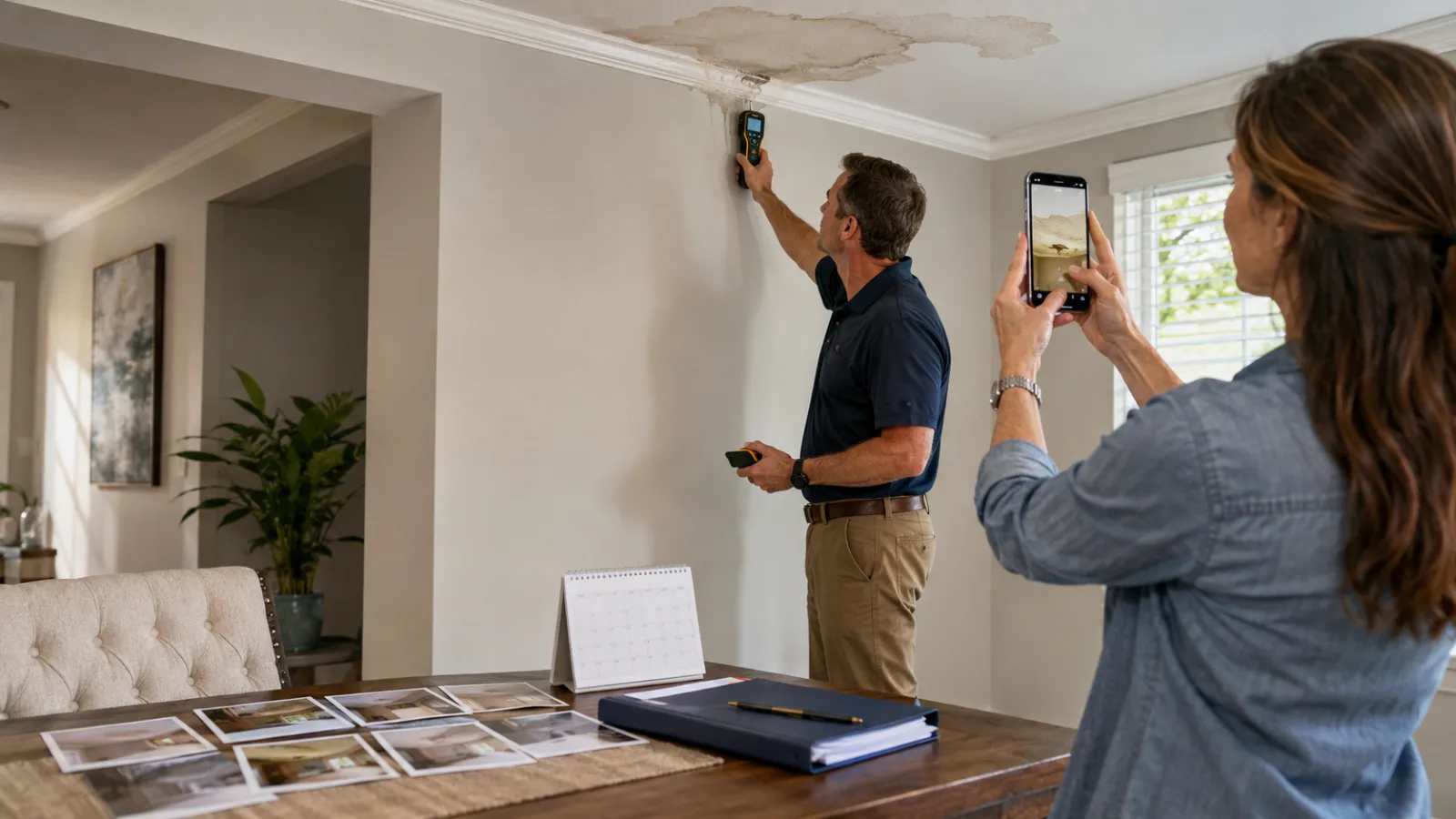
Photos are obvious, but the value is in the metadata. Digital images carry EXIF data—the date, time, and often GPS coordinates baked into the file. Original photos (not screenshots or texts, which strip the data) can independently confirm when a condition existed. If you have any older photos of the property showing the area undamaged—listing photos, family pictures, a shot of the kids in the backyard with the roof in the background—those "before" images are gold, because they establish the damage did not exist as of that date.
3. Prior inspection and real-estate records
Florida homeowners are inspected constantly, and each inspection is a dated snapshot of your property's condition:
- Four-point and wind mitigation inspections (required by many carriers) document roof age and condition on a specific date.
- Home purchase / buyer's inspection reports show the state of the roof, plumbing, and structure when you bought.
- Prior appraisals or mortgage inspections can do the same.
If a wind mit from 18 months ago shows a sound roof, the insurer's "years of deterioration" theory collapses.
4. Maintenance records and receipts
Invoices for a recent re-roof, roof repair, plumbing work, or routine maintenance establish that the component was in good condition as of the service date—and that you were not neglecting it. A roof replaced three years ago is not "worn out."
5. A forensic assessment of the damage itself
The damage carries its own evidence of when it happened. A qualified forensic evaluation—often from a licensed roofing or engineering professional—can distinguish recent mechanical or wind damage from long-term aging by examining the character of the damage, not just its existence:
- Freshness of mat fractures and the exposed asphalt at break points
- Granule loss patterns consistent with impact versus gradual weathering
- Absence of oxidation, dirt, or biological growth at the damage site (fresh breaks look fresh)
- Directional consistency with the recorded wind field of a specific storm
Because I also hold Florida general and roofing contractor licenses, this is where the "carrier adjuster who is also a contractor" perspective matters most—the physical evidence on the roof frequently contradicts the "old damage" label written from a desk. A documented roof assessment from a licensed Florida roofing contractor can anchor this part of your file.
6. Aerial and satellite imagery
Historical aerial imagery lets you compare "before" and "after" views of your roof or property. A clear roof in an image dated before the storm, and damage after, brackets the loss to a specific window—without you ever setting foot on the roof.
7. Your CLUE report and prior-claims history
A Comprehensive Loss Underwriting Exchange (CLUE) report shows prior claims on the property. If there is no prior claim for the area now in dispute, that undercuts any suggestion the damage is old or previously reported. (For more on this, see our guide to CLUE reports.)
The Florida Deadline Wrinkle You Cannot Ignore
Proving when damage happened is not only about coverage—it is about your right to file at all. Under Florida Statute § 627.70132, as rewritten by SB 2-A in late 2022, you generally must give notice of a new or reopened property claim within one year of the date of loss, and a supplemental claim within 18 months. That clock runs from the date of the event, not the date you discovered the damage. (Florida courts recognize only a narrow "discovery rule" exception for genuinely hidden damage, and it is hard to prove.)
This is exactly why the "old damage" argument is so useful to carriers: if they can push your date of loss back far enough, they can argue the claim is both excluded and time-barred. Nailing down a specific, recent, NOAA-verified date of loss is your best defense on both fronts. It also explains why slow leaks and hidden water intrusion are so risky—hidden damage from a storm is still on the one-year clock, so the safe move is a professional inspection right after any event that could have caused damage.
What to Do If the Carrier Won't Budge
If you have built your timeline and the insurer still holds the "old damage" line, you have options short of a lawsuit. Most Florida policies contain an appraisal clause, a contractual process where each side names an appraiser and a neutral umpire resolves the dispute over the amount of loss. Appraisal is often faster and cheaper than litigation and can be effective when the fight is really about scope and causation. (For water losses specifically, the "sudden versus gradual" distinction has its own nuances—see our post on sudden-and-accidental water damage.)
How a Public Adjuster Helps
Rebutting an "old damage" denial is document-heavy, and the carrier does this every day. A licensed public adjuster works only for you—not the insurance company—to build the timeline, pull the NOAA and CLUE records, commission the right forensic assessment, re-inspect the property, and put the burden of proof back where the policy actually places it.
At NeJame Claims Adjusting, I bring all three sides of the table to the file: carrier-side adjusting experience (I know how the "old damage" call gets made), a licensed Florida public adjuster's authority to represent you, and roofing/general contractor licensing to document the physical evidence. If you have received a denial or lowball offer that blames "wear and tear" or "pre-existing damage," it is worth a second look before you accept it.
Have an "old damage" denial you want reviewed? Contact NeJame Claims Adjusting for a review of your policy and your options.
Frequently Asked Questions
Can an insurance company deny my claim just by saying the damage is old? No. Calling damage "old" invokes a wear-and-tear or deterioration exclusion, and under a Florida open-perils policy the insurer generally bears the burden of proving that exclusion applies once you show a loss occurred during your policy period. A bare assertion is not proof.
What is the single best way to prove my damage is recent? Tie it to a specific, NOAA-verified weather event using the NCEI Storm Events Database or National Hurricane Center records. Because Florida law defines the date of loss for weather events by NOAA verification, this is the same evidence the insurer's own framework relies on.
How long do I have to file a property insurance claim in Florida? Generally one year from the date of loss for a new or reopened claim, and 18 months for a supplemental claim, under Florida Statute § 627.70132. The clock runs from the event date, not the date you discovered the damage.
Do old photos of my house really help? Yes. Original digital photos carry embedded date and location metadata, and any image showing the area undamaged before the loss brackets when the damage occurred. Save originals rather than screenshots, which strip that data.
Should I get my own inspection if the carrier says the damage is old? Yes. An independent forensic or roofing assessment can document features that distinguish recent damage from long-term aging, and it gives you evidence to challenge the carrier's conclusion rather than simply disagreeing with it.
This article is general information about the Florida property insurance claims process and is not legal advice. Every policy and claim is different; coverage depends on your specific policy language and facts. For guidance on your situation, consult a licensed public adjuster or attorney.