Nothing Is Missing, So Nothing Is Damaged? What a Creased Shingle Actually Means
There is a version of a Central Florida roof inspection that goes like this. The adjuster pulls up, stands in the driveway, looks up at the roof, and sees a full field of shingles. Nothing is missing. Nothing is flapping. No blue tarp, no bare decking, no shingles in the yard. The file gets a note that reads no visible damage, and the claim is closed.
The adjuster is not lying. From where he was standing, the roof looked fine. It probably looked fine from the drone, too, and it certainly looked fine in the aerial imagery the desk adjuster pulled up afterward.
The problem is that the most common form of wind damage to an asphalt shingle roof is nearly invisible from any of those vantage points. You have to be on the roof, close to the surface, looking across the plane of it, to see it at all.
What a crease actually is
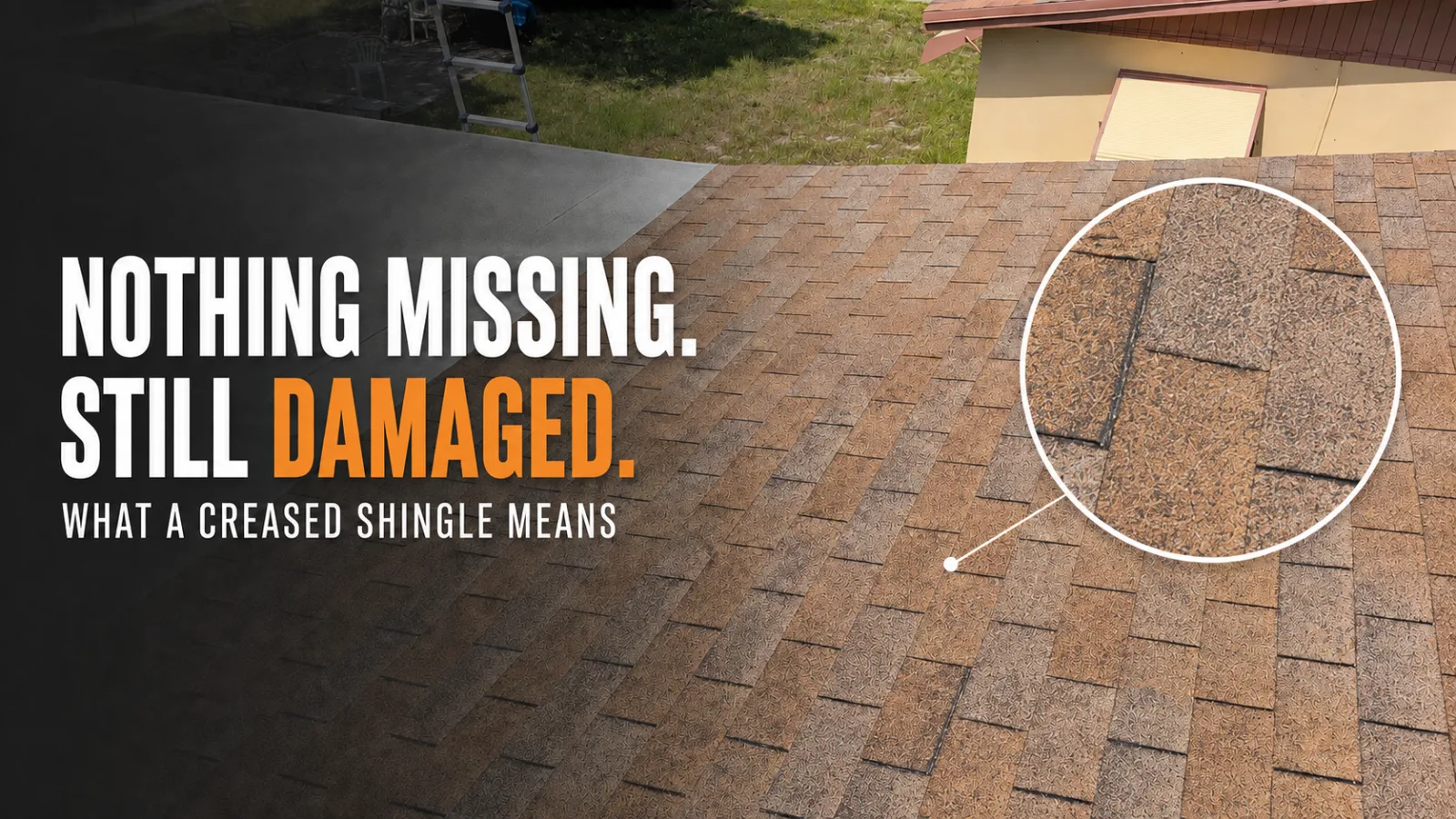
When wind gets under the leading edge of a shingle tab, it lifts it. If the lift is strong enough, the tab folds back on itself — and when it lays back down, it leaves a fracture line running horizontally across the shingle where it bent.
That fracture is the damage. Not the lifting, not the noise, not whether the shingle is still on the roof afterward. The fold breaks the asphalt-saturated mat that gives the shingle its structural integrity and its ability to shed water. Once the mat is fractured through, the shingle is a compromised piece of material even though it is lying perfectly flat and looks, from twenty feet away, exactly like every shingle around it.
Two things happen at the same time, and both matter for a claim:
The mat is broken. The shingle has lost strength along that line. It will continue to flex there with thermal cycling and every subsequent wind event, and the fracture will open.
The seal is broken. Asphalt shingles are held down not just by nails but by a thermal sealant strip that bonds each course to the one below it. When wind lifts a tab far enough to crease it, that bond is broken. A shingle that has been unsealed does not reliably re-seal — Florida heat may tack it back down cosmetically, but the original factory bond is gone. That shingle is now the weak point where the next storm starts.
This is why "it's still on the roof" is not the test. A creased shingle is a shingle that already failed; it just has not left yet.
Why creasing is the most-disputed wind indicator in Florida
Creasing sits in an unfortunate place: it is genuinely hard to see, and it is genuinely consequential. That combination produces disputes.
It does not photograph itself. A crease shows up when light rakes across it at a low angle. Photograph the same shingle from directly overhead at noon and the crease can disappear entirely into the granule texture. Documentation of creasing is a technique, not a snapshot.
It survives the inspection methods carriers increasingly rely on. Ground-level looks, drone flights at altitude, and aerial imagery all capture the roof as a plane. Creasing is a detail in the surface of that plane. None of those methods are designed to find it. This is the roof-specific version of a broader problem we covered in what happens when the carrier inspects only part of the loss — the scope of the inspection quietly becomes the scope of the claim.
It is easy to reframe as age. An adjuster who does see a crease can characterize it as ordinary weathering, curling, or manufacturing variation rather than wind. This is the same argument covered in our post on proving when damage happened — and the response is the same. Creasing has a character that distinguishes it from age. A wind crease is a discrete horizontal line consistent with a fold, often oriented consistently across a slope in the direction of the recorded wind field, with fresh asphalt visible at the fracture rather than oxidized, dirt-filled, or biologically colonized material. Weathering does not produce a clean directional fold line.
It usually is not one shingle. Wind does not crease a single tab in isolation. When creasing is present, it tends to appear in a pattern across the windward slopes — which is exactly what turns a repair conversation into a replacement conversation, and exactly why carriers scrutinize it.
What this means for the scope of your claim
This is where the stakes actually live. The dispute over creasing is rarely about whether one shingle is damaged. It is about how much roof the claim covers.
A carrier that acknowledges a handful of creased shingles will often propose replacing those shingles. That raises questions a homeowner is not equipped to argue: whether the surrounding shingles can be lifted to access the damaged ones without breaking their seals too, whether a matching shingle is still manufactured, and whether a spot repair on a slope with distributed creasing is a real repair or a patch that fails at the next storm.
Florida's building code also has rules governing when a roof repair becomes a required replacement, and those rules have changed more than once in recent years — including provisions tied to the age of the roof and the code edition it was built under. Whether a given roof falls under a repair or a replacement requirement depends on the specifics. Our sister company Orange Contracting and Roofing has written a plain-language walkthrough of how that repair-versus-replacement call gets made in Florida, which is a useful companion to the claim side of this question.
How to document creasing properly
If you think your roof took wind and the carrier said otherwise, the documentation is the whole ballgame.
Get on the roof, or get someone qualified up there. Nothing else finds creasing. If accessing the roof is not safe for you, that is a reason to bring in a professional, not a reason to skip it.
Shoot with raking light. Early morning or late afternoon, with the sun low and across the slope. Shoot along the plane of the roof rather than straight down at it. The same crease that is invisible at noon is obvious at 8 a.m.
Establish location, then show the detail. A tight close-up of a crease proves nothing about where on the roof it is. Pair every detail shot with a wide shot that places it on a specific slope and elevation.
Map the pattern. Mark creased shingles by slope and count them. A distribution across the windward faces tells a story that a scattering of individual photos does not.
Tie it to a date. Pull the storm verification for the wind event you believe caused it. The NOAA NCEI Storm Events Database documents high winds, hail, and severe storms by county and date, and the National Hurricane Center publishes official landfall data for named storms. Creasing that lines up directionally with a documented wind field is far harder to dismiss as age. This matters twice over, because Florida Statute § 627.70132 generally requires notice of a new or reopened claim within one year of the date of loss, and a supplemental claim within 18 months.
Know the carrier's own clock. Under Florida Statute § 627.70131, an insurer that conducts a physical inspection must do so within 30 days of receiving proof-of-loss statements, must send you a copy of its detailed estimate within 7 days of the adjuster generating it, and must pay or deny within 60 days of notice. Ask for the estimate. It is the document that shows you what was and was not scoped.
Preserve everything before repairs. Once a slope is torn off, the evidence is in a dumpster.
Where we come in
The photos in this week's social post are from a roof that would have passed a ground-level look without a second thought. Getting on it was the difference.
At NeJame Claims Adjusting, roof inspections are done on the roof, close to the surface, documented in a format that can survive a dispute. Because I also hold Florida general and roofing contractor licenses alongside the public adjuster license, the assessment covers both what happened to the material and what the repair actually requires — which is usually where the carrier's estimate and reality separate.
If your Central Florida roof claim was closed with no visible damage, that is a denial worth revisiting. If it came back covering a few shingles when the slope tells a different story, that is an underpaid claim. Either way the file is worth reopening before you accept it. When documentation alone will not close the gap, appraisal may be the next step.
Two related reads if a storm is what brought you here: what your hurricane deductible actually costs and our hurricane season claim-readiness guide. You can also pull your own claims history through our walkthrough of the free LexisNexis C.L.U.E. report, and find documentation checklists among our free claim tools.
Request a free claim review or call (407) 637-1000.
NeJame Claims Adjusting is a licensed Florida public adjusting firm (Firm License W805417, Designated Adjuster License P124170) serving Orlando, Maitland, Winter Park, Altamonte Springs, Lake Mary, Sanford, Kissimmee, Clermont, and Orange and Seminole Counties. This article is general information about the Florida claim process and is not legal advice or a coverage determination for any specific claim. Claim outcomes depend on the policy, damage, evidence, timing, and circumstances. No particular result is promised.