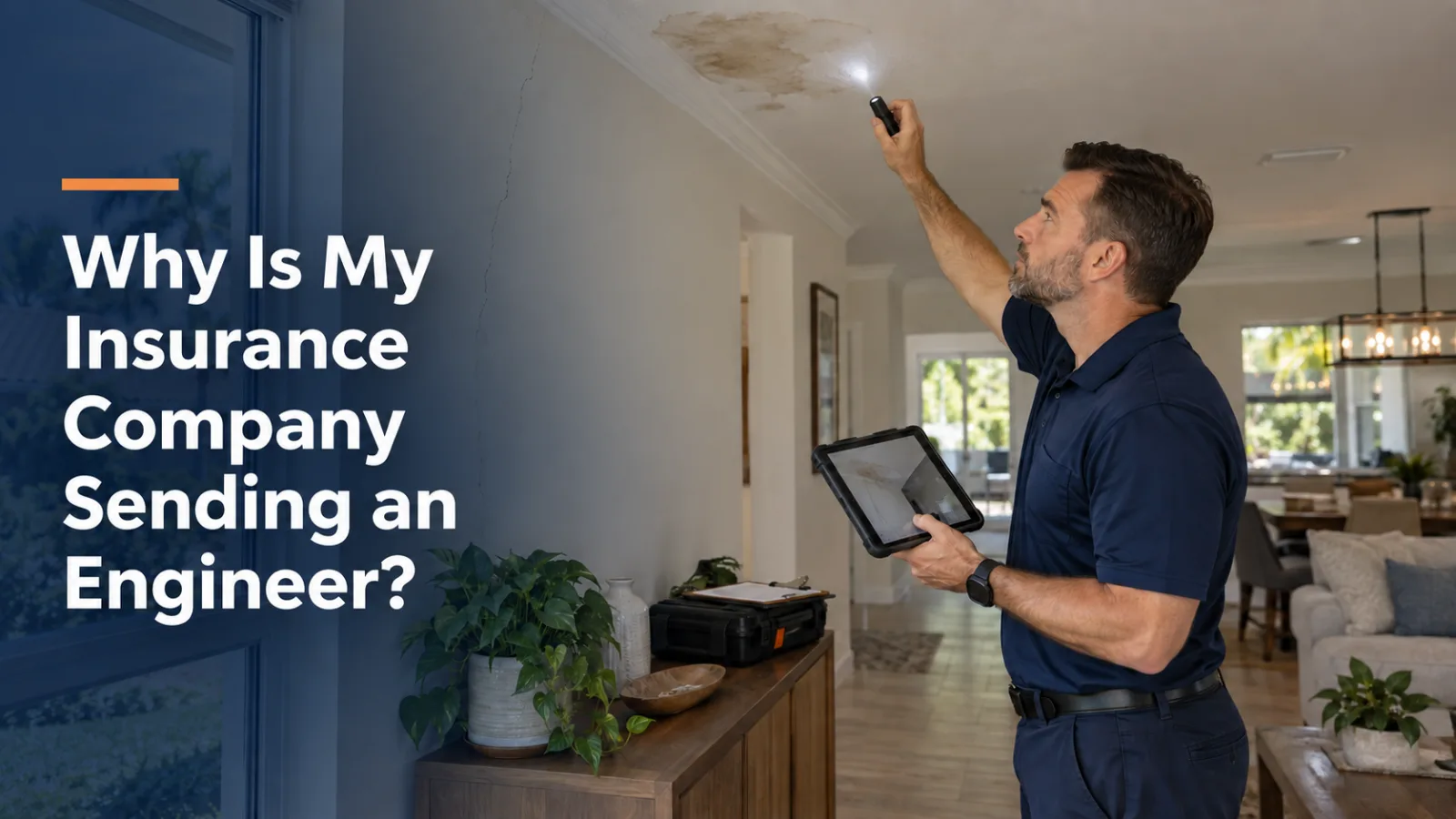
Why Is My Insurance Company Sending an Engineer to Inspect My Home?
If your insurance company is sending an engineer, it usually means the carrier wants a technical opinion about what caused the damage, when it occurred, or whether the proposed repair is necessary. That does not mean your claim will be denied. It does mean the inspection may carry significant weight in the carrier's decision.
The engineer does not make the coverage decision. The insurance company does. Still, if the engineer concludes that a roof leak came from long-term deterioration, a wall crack resulted from settlement, or wind damage occurred years before the reported loss, that opinion may become the factual basis for a denial or limited payment.
Homeowners often hear the word “engineer” and assume the dispute has been settled by science. It hasn't. An engineering report is an opinion based on the areas inspected, information reviewed, tests performed, assumptions made, and reasoning explained in the report. Those parts deserve as much attention as the conclusion.
Why does an insurance company hire an engineer?
A carrier may use an engineer when the cause of damage is disputed or cannot be determined through an ordinary adjuster inspection. Common examples include:
- Wind, hail, or impact damage to a roof
- Cracking, movement, or suspected structural damage
- Water intrusion with more than one possible source
- Fire, lightning, or electrical damage
- Damage that may be related to construction defects, wear, settlement, or prior repairs
- A disagreement between the homeowner's contractor and the carrier's adjuster
Sometimes an engineer is the right person for the question. A structural concern should not be decided by someone who lacks structural training. An unusual electrical loss may require testing beyond a visual inspection.
The concern begins when the assignment is framed too narrowly. If an engineer is asked only whether age or wear contributed to a roof condition, the report may spend ten pages answering that question without squarely addressing whether a recent storm also caused damage. A technically accurate answer to a narrow question can still leave the claim's main issue unresolved.
Is the insurance company's engineer independent?
The engineer should provide a professional opinion based on the evidence and applicable engineering standards. At the same time, the insurance company selected and paid the engineering firm for the assignment. Both facts can be true.
That relationship does not prove bias, and it does not make the report unreliable by itself. It does tell you why the report should be evaluated on its work rather than accepted because of the engineer's title.
Florida regulates the practice of engineering. The Florida Board of Professional Engineers explains that professional engineers are responsible for meeting acceptable engineering standards. The Board's rules also treat an untruthful, deceptive, or misleading professional report, or the omission of pertinent information that could lead to a false conclusion, as potential misconduct.
You can verify a Florida professional engineer's license through the state's licensing portal. License verification is a sensible first check, but an active license does not answer whether the report's conclusion is supported by the inspection.
What should you do before the engineer arrives?
Do not try to rehearse an argument or tell the engineer what conclusion to reach. Preserve the evidence and make sure the inspection is capable of addressing the actual damage.
Start by gathering the records that establish the property's condition and the timing of the loss:
- Photos and videos taken before and after the reported event
- Inspection reports, including four-point, wind mitigation, and home-purchase inspections
- Repair and maintenance invoices
- Permits and reroof records
- Weather records tied to the reported date of loss
- Photos of leaks, broken materials, temporary repairs, or emergency mitigation
- Reports or estimates from contractors who inspected the property
Keep original photo files when possible. A screenshot or image copied through a messaging app may lose useful date, time, or location data.
Write down the symptoms you observed and when you first observed them. Stick to what you know. “We first saw water on the floor after the storm” is useful. Guessing that wind lifted a particular shingle is not, unless you personally saw it happen.
If a contractor, public adjuster, or other qualified representative is involved, ask whether that person should attend. An engineer may understand structural behavior but still miss practical information about the roof system, prior repairs, material availability, or how water moved through the building.
What should happen during the inspection?
The scope depends on the reported damage. There is no universal checklist that makes every engineering inspection complete. A roof claim may require examination of each slope, attic conditions, interior damage, fasteners, repairs, weather data, and the claimed wind direction. A structural claim may call for measurements, elevation data, crack mapping, foundation observations, and a review of construction documents.
Pay attention to what the engineer actually does:
- Which rooms, elevations, roof slopes, or building components were inspected?
- Were measurements or tests taken? If so, where and with what equipment?
- Did the engineer enter the attic, inspect the roof surface, or examine the reported source?
- Were damaged and undamaged areas compared?
- Did the engineer ask about prior repairs, leaks, claims, or inspections?
- Were documents or photographs requested?
- Was any area inaccessible, covered, repaired, or excluded from the inspection?
Take your own photographs of the conditions present on inspection day. Keep notes about who attended, when the inspection started and ended, the areas visited, and any testing performed. You do not need to hover over the engineer or turn the visit into a confrontation. You need an accurate record.
This is especially important when the engineer's inspection is more limited than the later report makes it sound. Our article on incomplete insurance inspections in Florida explains how uninspected areas can quietly disappear from the carrier's scope.
What should you look for in the engineer's report?
Ask the carrier in writing for the complete report and every photograph, diagram, test result, weather record, or other document used to support it. Florida law expressly requires an insurer to provide a reasonable written explanation of the policy and factual basis for a payment, denial, or partial denial. Section 627.70131, Florida Statutes, also requires the insurer to maintain claim records that include claim-related inspections.
The statute expressly requires the carrier to send a detailed estimate generated by its adjuster within seven days after the estimate is created. It does not use the same automatic-delivery language for every engineering report, so make the report request directly rather than assuming it will arrive with the decision.
When you receive the report, do not begin with whether you agree with the last paragraph. Check how the engineer got there.
Does the report answer the right question?
A report may explain why a roof shows age-related deterioration without deciding whether wind caused separate, recent damage. It may identify long-term movement in one area without addressing new cracking elsewhere. Separate observations should not be collapsed into one cause without an explanation.
Does the report match the inspection?
Compare the report's description of the inspection with your notes and photographs. If it says the roof was evaluated but only one slope was accessed, that limitation belongs in the analysis. If the report discusses attic conditions but the attic was not entered, find out what evidence supports the statement.
Are important facts missing?
A report may be weakened by records the engineer never reviewed: a pre-loss inspection showing no damage, photographs taken immediately after the event, repair invoices, weather data, or evidence of interior leakage in the same area.
Missing information does not automatically make the conclusion wrong. It may mean the conclusion should be reconsidered after the missing information is supplied.
Does the reasoning connect the evidence to the conclusion?
Statements such as “consistent with wear and tear” or “not caused by wind” are conclusions. The report should explain the physical observations, testing, data, and engineering principles that support them. It should also address material evidence pointing the other way.
Does the report claim more certainty than the evidence allows?
An engineer may be able to say that a condition developed over time. Assigning that condition to one exact storm from years earlier is a different opinion and should have its own support. Weather records showing that a storm occurred do not, by themselves, prove that the storm caused the particular damage being inspected.
If the carrier says the damage is old or predates the policy, read how to document when property damage occurred. The date question is often resolved through a timeline built from several independent records, not one photograph or one weather report.
Can you dispute the insurance company's engineering report?
Yes. Disputing the report takes more than saying the engineer is wrong. A useful response identifies the specific factual omission, unsupported assumption, inconsistent observation, missing test, or reasoning gap and supplies evidence that changes the analysis.
Depending on the issue, that response may include:
- Dated pre-loss and post-loss photographs
- A prior inspection report
- A contractor's documentation of conditions the engineer did not address
- Weather data relevant to the property and date of loss
- A request for the engineer to review additional evidence and issue an addendum
- A second opinion from a qualified professional in the relevant discipline
- A request for another inspection of omitted or inaccessible areas
Do not hire an expert merely to produce the opposite conclusion. The second professional should have the right qualifications, review the relevant evidence, inspect what needs to be inspected, and explain the reasoning. Two competing conclusions without the underlying analysis do not move the claim very far.
If the report has already been used to deny the claim, our guide to disputing a denied homeowners insurance claim in Florida explains the broader options. Those may include a documented request for reconsideration, mediation, appraisal when the dispute is appropriate for appraisal, or legal review.
An engineering disagreement is not automatically professional misconduct. If you have evidence of an actual violation of Florida's engineering laws or rules, the Florida Board of Professional Engineers has a complaint process. A regulatory complaint is not a substitute for responding to the carrier within the claim, and it should not be used merely because you dislike the result.
How a public adjuster can help with an engineer inspection
A public adjuster does not replace a professional engineer. The roles are different.
The public adjuster's job is to keep the technical inspection connected to the entire claim: the reported event, policy, damage, repair scope, timeline, photographs, estimates, and carrier communications. That includes making sure relevant records reach the engineer, documenting the inspection, reviewing whether the report addresses the observed damage, and presenting unresolved facts to the carrier in writing.
At NeJame Claims Adjusting, we represent the policyholder, not the insurance company. Our review combines claim-handling experience with practical construction and roofing knowledge. If an engineer's report has become the basis for a denied or underpaid claim, we can review the report alongside the property conditions, policy, estimate, and carrier letter to determine what still needs to be answered.
Request a free claim review or call (407) 637-1000. We serve residential and commercial policyholders throughout Florida, with a primary focus on Central Florida.
Frequently asked questions
Why is my insurance company sending an engineer?
The carrier usually wants a technical opinion about the cause, timing, extent, or repairability of the damage. The inspection may be routine for a complex loss, but the resulting report can become a major part of the coverage decision.
Can an engineer deny my insurance claim?
No. The engineer gives a professional opinion. The insurance company decides whether to pay, partially pay, or deny the claim under the policy. The carrier may rely heavily on the engineer's conclusions when making that decision.
Am I entitled to the insurance company's engineer report?
Ask for the complete report and supporting materials in writing. Florida law requires a reasonable written explanation of the policy and factual basis for the carrier's decision, but the statute's automatic seven-day delivery requirement specifically refers to detailed estimates generated by an insurer's adjuster, not every engineering report.
Should I let the insurance company's engineer inspect my home?
Generally, policyholders have a duty to cooperate with a reasonable claim investigation under their policy. Refusing an inspection can create a separate claim problem. Review your policy, document the visit, preserve evidence, and obtain claim or legal guidance if the request appears unreasonable or unsafe.
Can I record the engineer's inspection?
Do not assume. Recording laws, privacy concerns, property access, and the type of recording can affect the answer. Photographs and written notes about your own property are usually the cleaner approach. Ask for legal advice before secretly recording a conversation.
What if the engineer ignores evidence I provided?
Send the evidence to the carrier again in a dated written communication. Identify what the report says, what evidence was omitted, and how that evidence could affect the conclusion. Ask whether the engineer reviewed it and request a supplemental response or addendum.
Do I need to hire my own engineer?
Not always. The first step may be correcting missing facts, obtaining the report, or documenting an incomplete inspection. A second engineer may make sense when the dispute depends on a genuine engineering question and the amount at issue justifies the cost.
This article provides general information about Florida property insurance claims. It is not legal advice, an engineering opinion, or a coverage determination. Every claim depends on its policy language, facts, evidence, timing, and circumstances. No particular result is promised.
Prepared by NeJame Claims Adjusting, Florida Firm License W805417, Designated Adjuster License P124170.