Hurricane Deductible vs. AOP Deductible: What Florida Homeowners Actually Pay
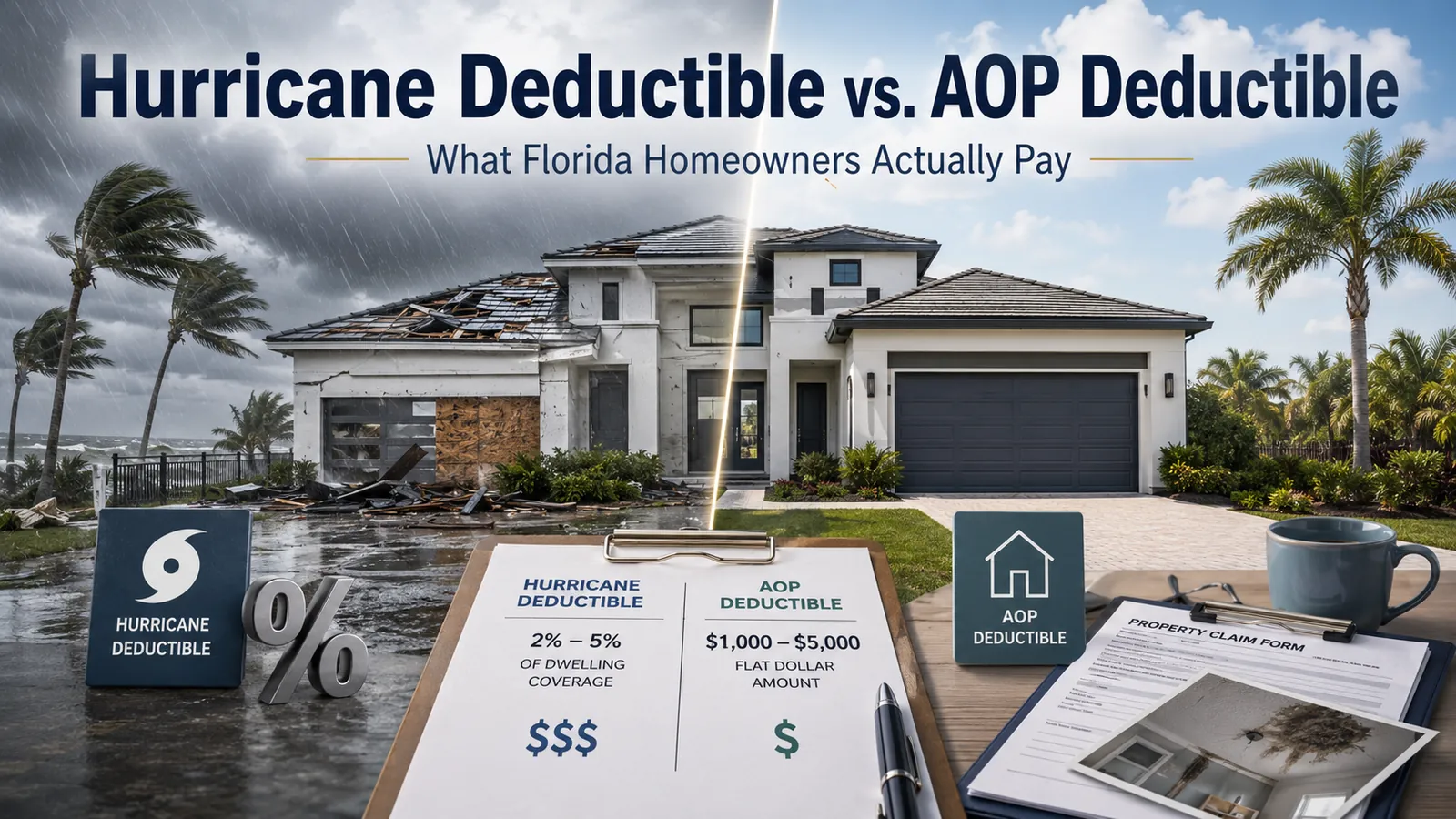
Quick answer: A Florida homeowners policy can have up to three deductibles. Your all-other-perils (AOP) deductible is a flat dollar amount — usually $1,000 or $2,500 — and it applies to everyday claims like a pipe burst or kitchen fire. Your hurricane deductible is a percentage of your home's dwelling coverage (2%, 5%, or 10%) that only kicks in during a named hurricane. Many newer policies also add a separate wind/hail deductible — often 1%–5% — for non-hurricane wind and hail, which can be equal to or higher than the other two. On a $400,000 home, a 5% hurricane deductible is $20,000 out of your pocket before the insurer pays a dime. Knowing which deductible applies — and making the carrier apply the right one — can swing your settlement by tens of thousands of dollars.
Every hurricane season I get the same call from Central Florida homeowners: "The adjuster came out, said my roof's covered, and then told me I owe $20,000 before they pay anything. How is that possible?"
It's possible because of how Florida stacks multiple separate deductibles into nearly every homeowners policy — and because most people never read the bold print on their declarations page until a storm forces them to. Many newer policies now carry three different deductibles, and the one that applies to your loss can change your settlement by tens of thousands of dollars. I spent years on the carrier side before I became a public adjuster, so I'll tell you exactly how each one works, where insurers get them wrong, and how to keep more of the money you're owed.
The Deductibles on Every Florida Policy
Your policy doesn't have a deductible. It has at least two — and increasingly, three.
1. The All-Other-Perils (AOP) Deductible This is the flat-dollar deductible you probably remember from signing your policy — commonly $1,000 or $2,500. It applies to the everyday, non-hurricane losses that make up most claims: a burst supply line, a roof leak from a regular thunderstorm, a fire, theft, or vandalism. If your AOP deductible is $2,500 and you have $12,000 in water damage, you pay the first $2,500 and the insurer covers $9,500.
2. The Hurricane Deductible This one is different in two big ways. It's a percentage of your dwelling coverage (Coverage A) rather than a flat dollar figure, and it only applies during an official hurricane event. Under Florida Statute 627.701, insurers are required to offer hurricane deductible options of $500, 2%, 5%, or 10% of your Coverage A limit. Most homeowners carry 2% or 5%.
The percentage is calculated against your dwelling limit — not the amount of damage. That's the part that catches people off guard.
3. The Separate Wind/Hail (Windstorm) Deductible This is the newest one — and the one I'm seeing on more and more Florida policies. A separate wind/hail deductible (sometimes called a "windstorm" deductible) applies to wind or hail damage that isn't part of a named hurricane: straight-line winds, a severe thunderstorm, a microburst, a hailstorm. Without it, that damage would normally fall under your flat AOP deductible. With it, the carrier routes those losses to a separate deductible that is frequently percentage-based — commonly 1% to 5% of Coverage A — and can be equal to, or even higher than, your AOP or hurricane deductible.
On that same $400,000 home, a 2% wind/hail deductible is $8,000 for a loss that, a few years ago, might have only cost you a $2,500 AOP deductible. Carriers add these because wind and hail drive a large share of Florida claims, and the separate deductible shifts more of that cost back onto you. The catch: many homeowners don't realize they have one until a non-hurricane storm hits and the math comes out very differently than they expected.
Run the Math: Why the Difference Is So Big
Let's take a home insured with $400,000 in dwelling coverage (Coverage A).
| Deductible | How it's calculated | What you pay out of pocket | |---|---|---| | AOP (flat) | Fixed dollar amount | $2,500 | | 2% hurricane | 2% × $400,000 | $8,000 | | 5% hurricane | 5% × $400,000 | $20,000 | | 10% hurricane | 10% × $400,000 | $40,000 |
Now picture $35,000 in storm damage to that home:
- If it's a non-hurricane windstorm (your AOP deductible applies): you pay $2,500, the insurer pays $32,500.
- If it's a named hurricane with a 5% deductible: you pay $20,000, the insurer pays $15,000.
Same damage. Same house. A $17,500 difference in your settlement — decided entirely by which deductible the carrier applies. That's why the deductible question is never just paperwork. It's often the single biggest number in your claim.
When Does the Hurricane Deductible Actually Apply?
This is where homeowners — and sometimes adjusters — get it wrong. The hurricane deductible is not triggered every time it's windy or rainy. Under Florida Statute 627.4025, it only applies during the official "hurricane event period," which:
- Begins when the National Hurricane Center issues a hurricane watch or warning for any part of Florida (not just your county),
- Includes the storm's landfall, and
- Ends 72 hours after the last watch or warning is lifted for all of Florida.
Any covered damage that happens inside that window is subject to the hurricane deductible. Damage from a tropical storm, a microburst, a regular Florida afternoon thunderstorm, or straight-line winds that were never part of a named hurricane falls outside the hurricane deductible. Where it lands instead depends on your policy: if you don't have a separate wind/hail deductible, that damage falls under your lower flat AOP deductible. If you do have a wind/hail deductible, the carrier will apply that percentage instead — which is exactly why it pays to know all three of your deductibles before a storm. You can confirm whether a watch or warning was in effect through the National Hurricane Center.
This distinction is worth real money, and carriers don't always get it right.
One Hurricane Deductible Per Year — Not Per Storm
Here's a provision that works in your favor and almost nobody knows about: in Florida, the hurricane deductible applies once per calendar year, not once per storm.
If you have the same insurer (or one in the same insurer group) and you've already satisfied your hurricane deductible on an earlier storm that year, your lower AOP deductible applies to any later hurricane losses in that same calendar year. After back-to-back seasons like 2024's, this rule has saved Florida homeowners thousands — but only if they catch it. If a carrier tries to charge you a second full hurricane deductible for a second storm in the same year, that's a red flag.
The Newer Wrinkle: Separate Roof Deductibles
Since the 2022–2023 reforms, Florida law also allows carriers to attach a separate roof deductible to your policy. Under Florida Statute 627.701(10), a roof deductible can't exceed the lesser of 2% of your Coverage A limit or 50% of the cost to replace your roof — and you have to be given the option to decline it at issuance.
If your roof is the damaged component, check your declarations page for this separate line item before you assume which deductible applies. Getting an accurate, Florida-specific replacement cost matters here — our colleagues at Orange Contracting & Roofing keep a Florida Roof Lifespan Calculator that's useful for understanding where your roof stands before a claim ever starts.
How Insurers Get the Deductible Wrong
From my years reviewing claims on the carrier side, here's where I see homeowners overpay:
- Applying the hurricane deductible to a non-hurricane loss. If the damage happened outside the hurricane event period, the hurricane deductible shouldn't apply at all — the loss belongs under your AOP or wind/hail deductible. Carriers sometimes default to the higher percentage deductible because it reduces what they owe.
- Applying a wind/hail deductible to a loss that wasn't wind or hail — or applying it when your policy never included one. Pull your dec page and confirm the deductible the carrier used actually matches both your policy and the cause of loss.
- Charging a second hurricane deductible in the same calendar year when the AOP deductible should apply to the later storm.
- Calculating the percentage against the wrong number. It should be your Coverage A dwelling limit — applied correctly, with the dollar figure disclosed.
- Failing to meet disclosure requirements. Florida Statute 627.701(3) requires the hurricane deductible to be stated in bold type on your declarations page. Disclosure gaps can become grounds to challenge how the deductible was applied.
When the dispute is about which deductible applies — or about the value of the loss itself — that's squarely a valuation fight. If you and your carrier disagree on the numbers, the appraisal process is often a faster, cheaper path than litigation. And if your claim was underpaid or wrongly denied, you have options.
What You Should Do Before the Next Storm
- Pull your declarations page today. Find every deductible listed — the flat AOP amount, the hurricane percentage, and any separate wind/hail percentage. Do the multiplication so you know your real out-of-pocket number for each one before a storm, not after.
- Check for a separate roof or wind/hail deductible. If either is there, factor it in — they're easy to miss and can be the biggest number on the page.
- Know your dwelling limit (Coverage A). That's the number your hurricane percentage is multiplied against.
- Document your home now. Photos and video of your roof, interior, and major systems before the season make a stronger claim later. (See our guide on why roof age and condition data matter.)
- Don't accept the deductible at face value after a loss. Confirm the storm was a named hurricane within the event period, and confirm it's your first hurricane deductible of the year.
The Bottom Line
In Florida, your deductible isn't one number — it's a decision the insurer makes about your claim, and that decision can cost or save you tens of thousands of dollars. The flat AOP deductible covers most of life's claims. The hurricane deductible — a percentage of your home's value — applies only during a named hurricane, once per calendar year, and only when it's correctly triggered. And a growing number of policies now slot a separate wind/hail deductible in between, for the everyday wind and hail damage that used to fall under AOP. Knowing all three, and which one truly applies to your loss, is where the money is.
At NeJame Claims Adjusting, we read the fine print so you don't have to. Having worked claims from the inside, I know exactly where carriers cut corners on deductibles — and how to push back. If a storm hit your home and you're staring at a deductible that doesn't look right, let's talk before you sign anything.
Free claim review. No recovery, no fee.
NeJame Claims Adjusting Florida Licensed Public Adjusters — Serving Central Florida and Statewide 📞 (407) 637-1000 🌐 nejameclaims.com 📍 105 Candace Dr, Suite 129, Maitland, FL 32751
Additional resource: The Florida Department of Financial Services publishes a consumer guide to the hurricane deductible.