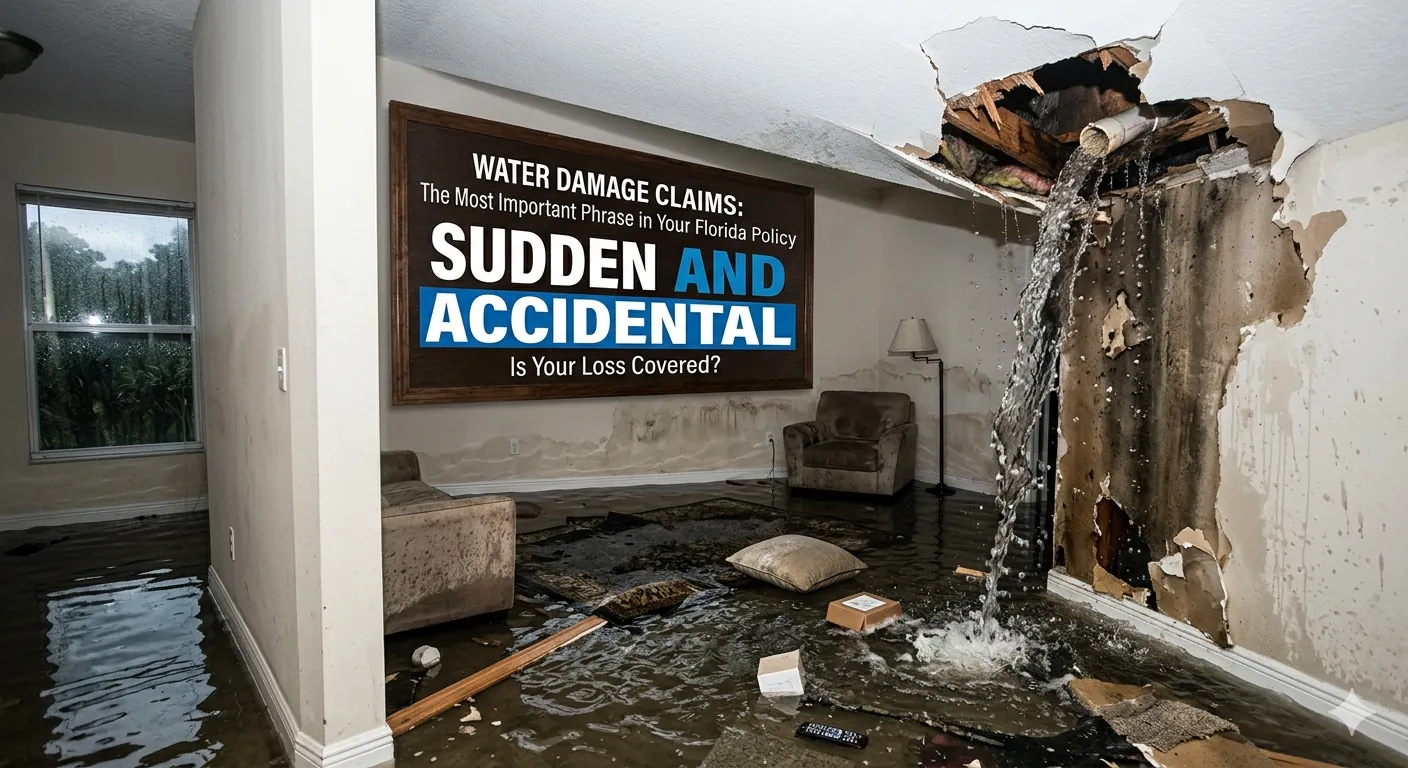
Water Damage Claims in Florida: Why "Sudden and Accidental" Is the Most Important Phrase in Your Policy
You come home from work to find water pooling on your kitchen floor. You trace it to a supply line under the sink that's spraying water. You shut off the valve, call your insurance company, and assume you're covered — after all, that's why you pay your premium every month.
Then the adjuster shows up. They look at the water staining on the inside of the cabinet. They point to some discoloration on the baseboard. And they write a report that says the damage was caused by a "long-term, slow leak" — not a "sudden and accidental" event. Claim denied.
If this sounds familiar, you're not alone. Water damage and freezing claims are the second most common type of homeowners insurance claim in the United States, accounting for roughly one in every four claims filed. The average payout on these claims exceeds $13,000 — which means insurance carriers have billions of reasons to look for ways to deny them.
And in Florida, the single most powerful tool in a carrier's denial playbook is the phrase "sudden and accidental."
What Does "Sudden and Accidental" Actually Mean?
Almost every standard homeowners insurance policy in Florida covers water damage — but only when it results from a "sudden and accidental" event. This is the coverage trigger. If the carrier determines that the water damage doesn't meet this standard, they'll deny the claim or significantly reduce the payout.
Here's what typically qualifies as sudden and accidental:
- A supply line to a toilet, sink, or appliance bursts without warning.
- A water heater fails and floods the garage or utility room.
- A washing machine hose ruptures during a cycle.
- Wind-driven rain enters through a roof breach caused by a storm.
- An air conditioning drain pan overflows due to a sudden clog.
And here's what carriers will argue does not qualify:
- A slow drip behind a wall that has been going on for weeks or months.
- Seepage around a shower pan that has gradually deteriorated.
- A roof leak that the carrier says you should have noticed and repaired.
- Condensation from an HVAC system that has been building over time.
- Any water damage they can characterize as a "maintenance issue."
The critical thing to understand is this: it doesn't matter when you discovered the damage. What matters — at least in the carrier's eyes — is when the damage started. If they can argue the water has been present for an extended period, they'll invoke the gradual damage exclusion and deny the claim, even if you genuinely had no idea the leak existed until the day you found the puddle on your floor.
How Carriers Build the Case Against You
I've seen the carrier's playbook from the inside. Before I became a licensed public adjuster, I worked as a staff adjuster for an insurance company. I know exactly how the investigation process works — and I know how carriers build a narrative to support a denial.
Here's what typically happens:
The field inspection. The carrier sends an adjuster (sometimes an independent adjuster, not even their own employee) to inspect the damage. This person is looking for physical evidence that supports a gradual-damage finding: staining patterns, mold or mildew growth, swelling in cabinetry, discoloration of grout, rust on pipes, or mineral deposits around fittings. Any of these can be used to argue the water has been present for longer than you reported.
The plumber's report. In many cases, the carrier will send a plumber to assess the source of the water. The plumber will document the condition of the pipe or fixture, note the age of the plumbing components, and — critically — offer an opinion on how long the leak may have been occurring. This opinion, which is often based on visual observation alone, can become the centerpiece of the denial.
The engineering report. On larger claims, the carrier may retain a forensic engineer. These reports can be thorough and legitimate, but they can also be outcome-driven. When the engineer is hired and paid by the carrier, there is an inherent incentive to reach conclusions that support a denial. I've reviewed engineering reports that reached sweeping conclusions about leak duration based on minimal physical evidence.
The denial letter. Armed with this documentation, the carrier issues a denial citing the gradual damage or constant seepage exclusion. The letter will reference specific policy language and the findings from the inspection, plumber, and/or engineer. Many homeowners read this letter and assume it's the final word. It isn't.
Why the Carrier's "Gradual Damage" Argument Isn't Always Right
There's an important distinction that carriers often blur: the presence of secondary damage does not automatically prove a long-term leak.
Water staining on drywall can develop in a matter of days under the right conditions — Florida's heat and humidity accelerate every water-related process. Mold can begin growing within 24 to 48 hours of a moisture event. Swelling in particle board cabinetry can happen rapidly when there is standing water inside a cabinet. Mineral deposits around a pipe fitting may have been present for years without any active leak.
A carrier's adjuster will often photograph these conditions and use them to support a narrative that the damage has been ongoing. But this narrative doesn't hold up when you examine the evidence carefully and understand the science behind how water damage actually progresses in a subtropical climate like Central Florida.
This is exactly where a public adjuster adds value. We don't accept the carrier's narrative at face value. We inspect the damage independently, bring in our own experts when needed, and build a documented case that tells the accurate story of what happened and when.
What You Should Do If You Discover Water Damage
The steps you take in the first 24 to 48 hours after discovering water damage will directly impact whether your claim gets paid. Here's what I recommend to every homeowner:
Stop the water source immediately. Shut off the supply valve to the affected fixture, or shut off the main water supply to the house if you can't isolate the leak. This is not just common sense — your policy requires you to mitigate further damage. Failing to do so gives the carrier another reason to reduce or deny the claim.
Document everything before you clean up. Take photos and video of the water source, the standing water, the affected materials, and any visible damage to walls, floors, cabinetry, and personal property. Do this before you start extracting water or removing damaged materials. This documentation is your evidence, and once it's gone, you can't recreate it.
Report the claim to your insurance company promptly. Florida policies have reporting windows, and late reporting is a common basis for denial. Call your carrier's claims line and get a claim number. Follow up in writing — email is fine — so you have a timestamped record of when you reported.
Do not make permanent repairs until the carrier has inspected. You are required to mitigate — meaning you should extract standing water, set up fans or dehumidifiers, and prevent further damage. But do not rip out drywall, replace flooring, or make permanent repairs until the carrier has had a reasonable opportunity to inspect. If you repair before they inspect, they'll argue they couldn't verify the damage.
Call a public adjuster before you accept any offer or denial. This is the single most important step most homeowners skip. A public adjuster works for you — not the insurance company. We understand the policy language, we know the carrier's tactics, and we document the damage to the standard required to get claims paid. Bringing a public adjuster in early — before the carrier's adjuster even shows up — gives you the strongest possible position.
The Florida-Specific Wrinkle: Limited Water Damage Coverage
Here's something many Florida homeowners don't realize: not all policies provide the same level of water damage coverage. Some Florida carriers — particularly those writing policies on older homes — issue policies with limited water damage coverage, which caps the payout at $10,000 per occurrence regardless of the actual repair cost.
If your home has aging plumbing, a roof over 15 years old, or is located in certain ZIP codes, there's a real chance you have limited water coverage and don't even know it. A supply line failure that causes $40,000 in damage to your floors, walls, and personal property could be capped at a $10,000 payout under a limited policy.
This is why it's critical to review your policy declarations page — not just your premium statement — before a loss ever occurs. If you have limited water coverage, talk to your agent about upgrading to full coverage. The premium increase is often modest compared to the financial exposure.
Don't Accept a Denial as the Final Answer
Insurance carriers count on the fact that most homeowners don't understand their policy well enough to challenge a denial. They use technical language, cite internal reports, and present the denial as an inevitable conclusion. But a denial letter is the beginning of a process, not the end of one.
At NeJame Claims Adjusting, we handle water damage claims across Central Florida every week. We've seen carriers deny claims that clearly qualified as sudden and accidental, underpay claims by tens of thousands of dollars, and pressure homeowners into accepting lowball settlements before they've had a chance to get an independent assessment.
If you've had a water damage claim denied — or if you've just discovered water damage and want to make sure your claim is handled properly from the start — call us at (407) 637-1000 or visit nejameclaims.com. The consultation is free, and we don't get paid unless you do.